
Dr. Wenhe Wang Publishes Structural Basis for Dual Mechanism of Cas2/3 Nuclease Inhibition by Anti-CRISPR Protein AcrIF19 in Nature Communications
Recently, Dr Wenhe Wang from the Department of Biology, School of Chemistry and Biological Engineering, University of Science and Technology Beijing, together with Prof Yong Wang and Prof Yongchao Xie from the College of Life Sciences, Shandong Agricultural University, Prof Yi Zhang from Beijing University of Chemical Technology, and Prof Lingguang Yang from Yichun University, has published a research article entitled “Structural basis for dual mechanism of Cas2/3 nuclease inhibition by anti-CRISPR protein AcrIF19” in Nature Communications. Dr Wenhe Wang is a co-corresponding author, and the Department of Biology, School of Chemistry and Biological Engineering, University of Science and Technology Beijing, is listed as a co-corresponding affiliation.
The study resolves high-resolution cryo-EM structures of the type I-F CRISPR–Cas core nuclease Cas2/3 in apo state (2.55 Å) and in complex with the anti-CRISPR protein AcrIF19 (2.97 Å). The authors show that AcrIF19 uses its β2–β3 acidic loop to insert into the single-stranded DNA entry channel of Cas2/3, creating steric hindrance that blocks substrate binding and thereby prevents substrate recruitment.
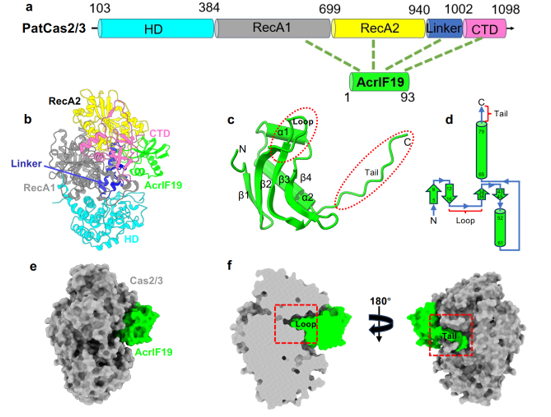
Overall cryo-EM structure of the Cas2/3-AcrIF19 complex.
Binding of AcrIF19 also stabilizes a native autoinhibited conformation of Cas2/3, in which a helical loop of the RecA1 domain occludes the catalytic center, abolishing DNA cleavage activity. Thus, AcrIF19 is established as a bifunctional anti-CRISPR protein that simultaneously inhibits substrate engagement and catalysis by Cas2/3, providing a structural basis for precise modulation of CRISPR activity and for improving the safety of CRISPR-based genome editing.
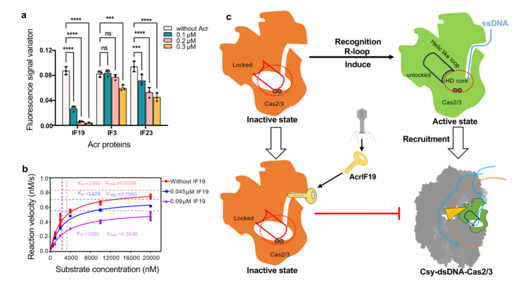
The Inhibitory Mechanism of AcrIF19.
The CRISPR–Cas system is a prokaryotic adaptive immune pathway that degrades invading phage DNA, whereas phage-encoded anti-CRISPR (Acr) proteins antagonize CRISPR–Cas components, forming a molecular arms race. In the type I-F system, Cas2/3 is the helicase–nuclease effector responsible for processive degradation of foreign DNA and is therefore essential for immune function. By dissecting Cas2/3 inhibition at near-atomic resolution, this work offers mechanistic insights applicable to the rational control of CRISPR systems.
Cryo-EM data collection and analysis were supported by the Cryo-EM Center, Southern University of Science and Technology, the Cryo-EM Platform, Peking University Health Science Center, the Tsinghua University Branch of China National Center for Protein Sciences (Beijing), and the Cryo-EM Center, Shandong Agricultural University. The research was funded by the National Natural Science Foundation of China and other funding programs.
Reference
Sa Y, Liu C, Yang L, et al. Structural basis for dual mechanism of Cas2/3 nuclease inhibition by anti‑CRISPR protein AcrIF19. Nature Communications. 2026.
