
Assoc. Prof. Liang Zhang Publishes Transformable Ink Writing Strategy for Soft 3D Architectures in Nature Communications
The latest research achievement of Assoc. Prof. Liang Zhang—transformable embedded ink writing (TEIW) 3D printing technology—has been published in the international journal Nature Communications under the title "Up-and-Down Transformable Embedded Ink Writing Strategy for Soft 3D Architectures". The first author is Yaxin Zhang, a doctoral candidate enrolled in 2022 at USTB.
Three-dimensional (3D) soft materials are crucial for advancing fields such as humanoid robots, soft robotics, wearable devices, and biological engineering. In recent years, extrusion-based 3D printing, particularly embedded ink writing (EIW), has become a vital tool for the rapid and customized fabrication of soft materials. However, existing technologies face challenges in achieving rheological compatibility between inks and support baths, as well as overcoming structural instability caused by nozzle disturbance and mechanical limitations during printing. These issues restrict the reliable fabrication of high-precision, large-scale, and complex topological 3D soft structures.
To address these problems, Assoc. Prof. Liang Zhang’s team at the School of Chemistry and Biological Engineering of University of Science and Technology Beijing proposed a novel D fabrication strategy—"Transformable Embedded Ink Writing". This method utilizes Newtonian-like fluids as the support bath, leveraging gravity and buoyancy to drive the self-assembly of printed 2D patterns into predefined 3D structures. This approach fundamentally bypasses the complexities of material rheology matching and intricate nozzle trajectory planning. The fabrication process is rapid, completing within seconds to minutes. Moreover, it offers advantages such as a wide range of printable materials and diverse forming modes. The strategy provides a universal and efficient new approach for the precise and rapid fabrication of complex 3D soft architectures.
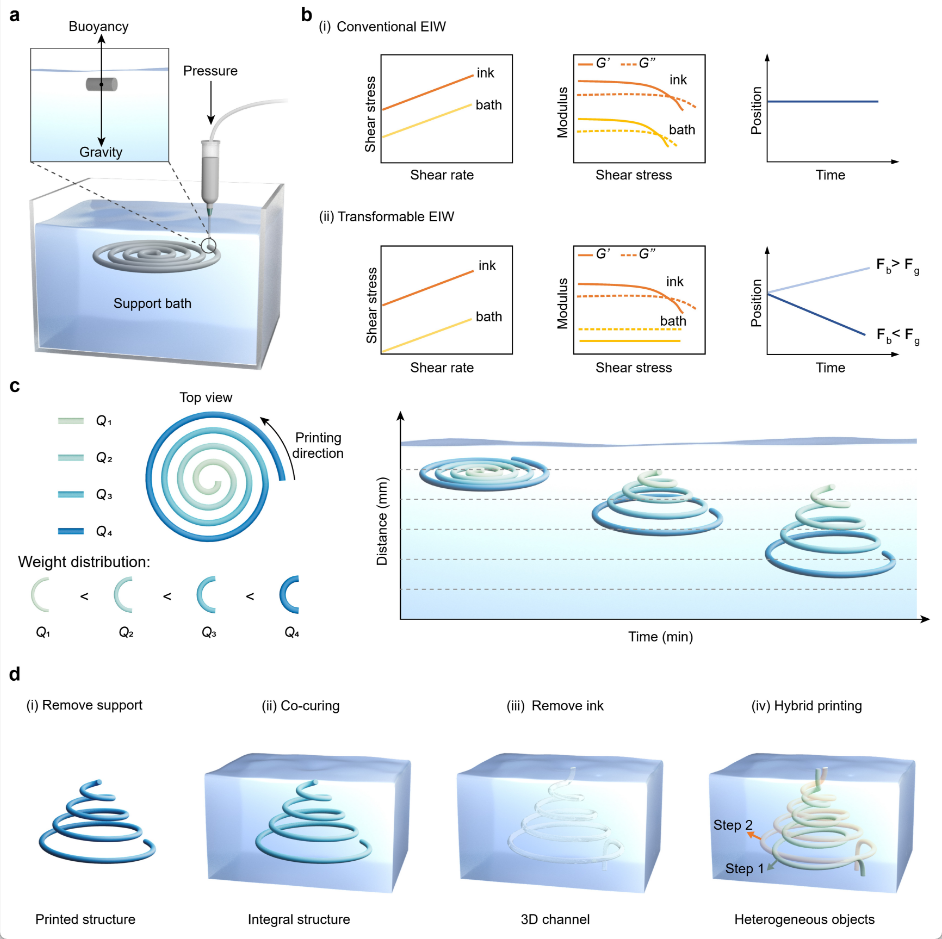
Figure. 1 Principle of TEIW.
Based on a modified Stokesian framework, this method quantitatively describes the interaction between the net buoyancy force generated by density differences and the viscous drag force dominated by the bath's viscosity, thereby achieving precise control over the sinking/floating behavior of printed filaments. It integrates the simplicity of 2D pattern fabrication with the complexity of 3D structures. Additionally, this method allows for the simultaneous integration of functional components (e.g., fluidic, electrical, and structural elements) within a single printing process. It opens a new pathway for manufacturing next-generation, highly integrated, and multifunctional intelligent soft devices applicable to fields like customizable microelectronics and perfusable networks.
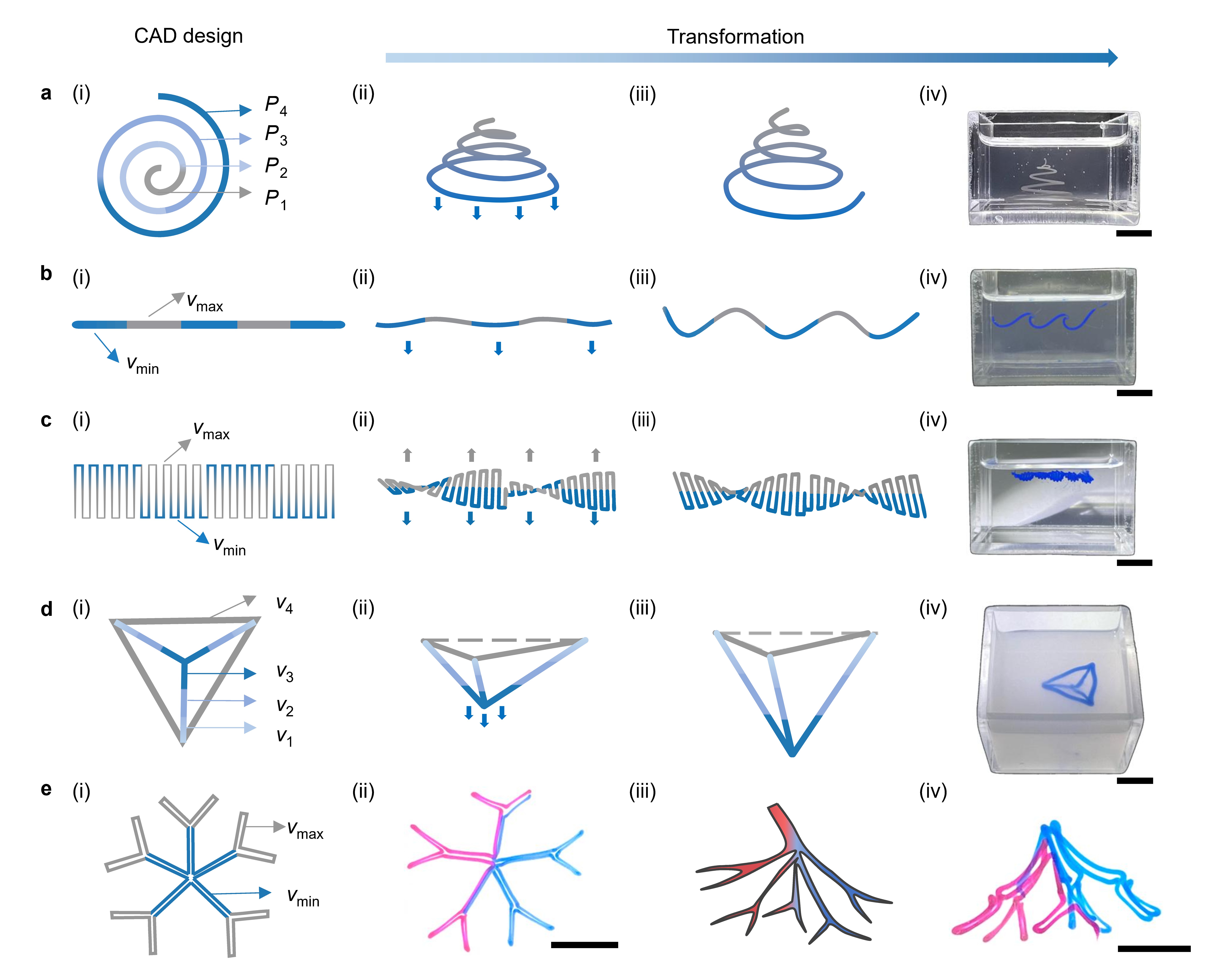
Figure. 2 Autonomous 2D-to-3D transformation.
Link to the original article: https://www.nature.com/articles/s41467-025-66418-z
